
Other computers
Your sessions run on your desktop, and you sit at your laptop. Pair the two, and the desktop’s sessions show in your laptop’s sidebar, next to its own. Claude keeps running on the computer that has the session; you follow and steer it from the other one.
Seshboard on another computer pairs with this one as a phone does, through Remote.
Set it up
Section titled “Set it up”The computer that runs the sessions needs Remote on, with a tunnel: see Choose a tunnel and Pair a device.
- On the computer that runs the sessions, turn Remote on, click Pair a device, then Copy link.
- On the other computer, open Settings → Remote (or Connect to another computer… in the command palette), paste the link under Other computers and click Connect.
- Both computers show the same 6 digits. Click Allow on the first one if they match.
The computer you paired shows under Paired devices on the first one, like a phone, and under Connected to this MacConnected to this PC while it is connected. See Who is connected now.
Its sessions in your sidebar
Section titled “Its sessions in your sidebar”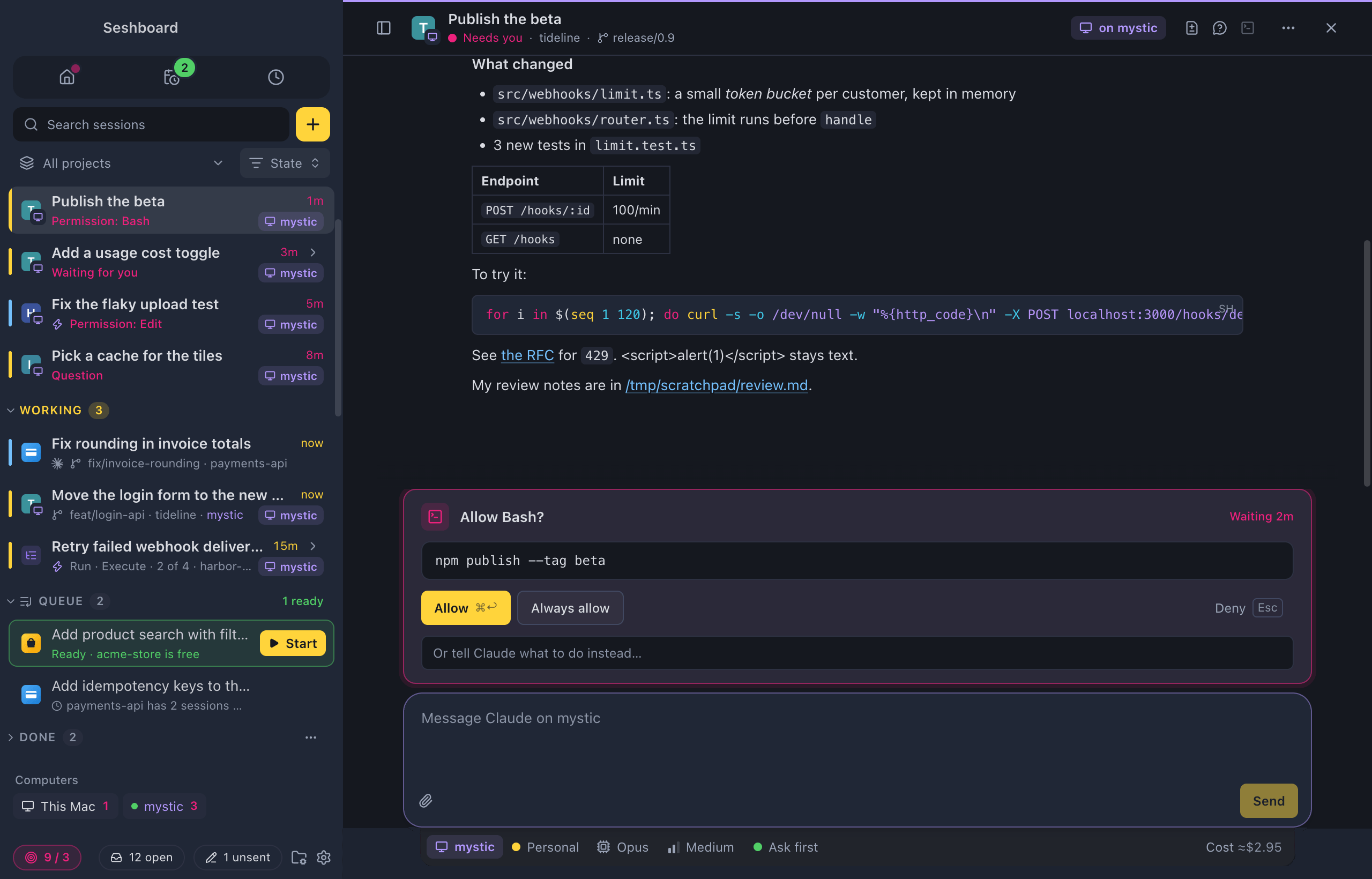
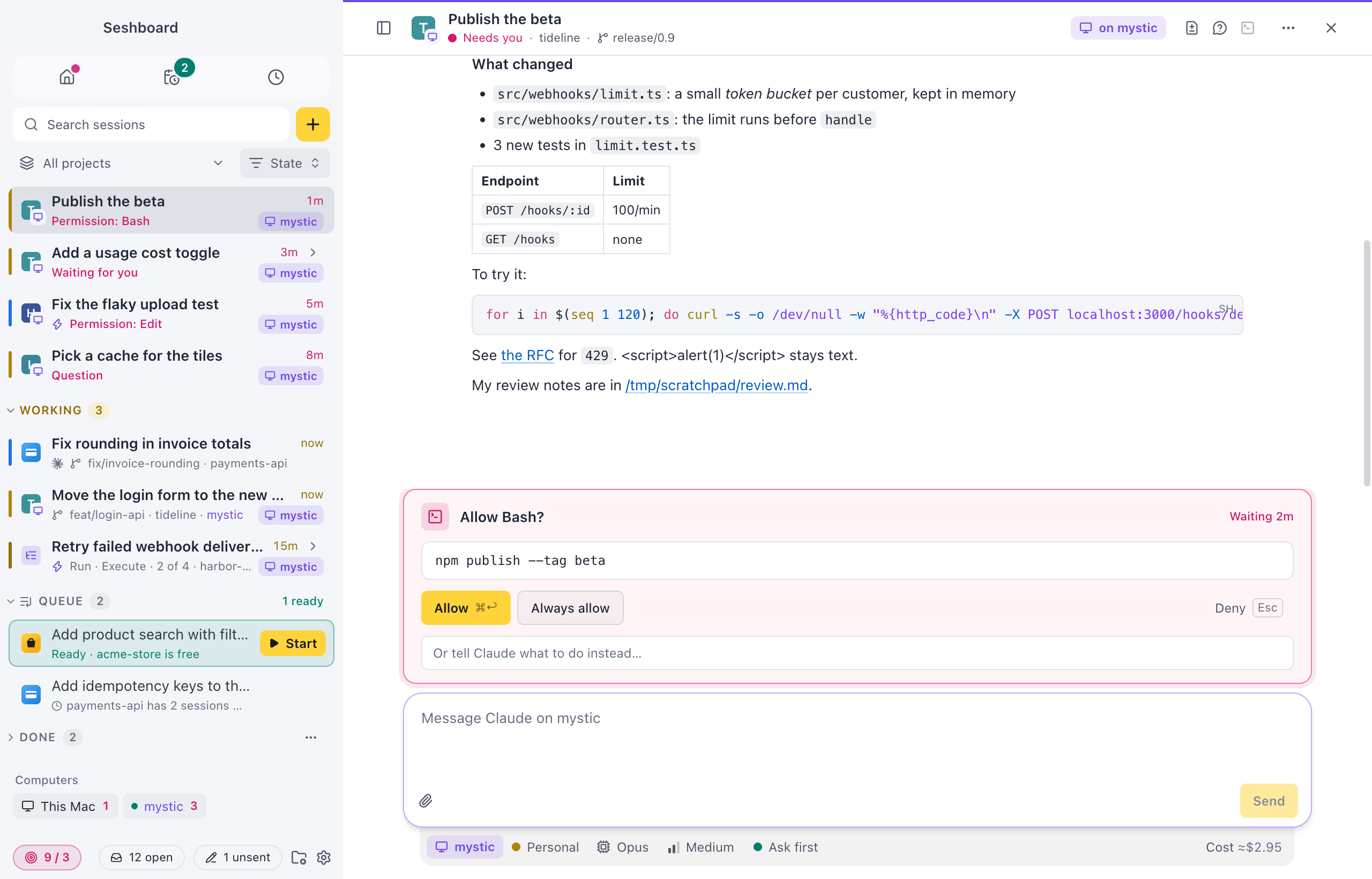
The other computer’s sessions sit in your sidebar, in the same groups as yours: Needs you, Working, To review and so on. Violet marks everything on another computer, and nothing else uses it:
- the project icon has a small monitor badge;
- the second line of the row ends with a chip with the computer’s name, such as mystic.
When that computer has more than one Claude profile, the row’s left line has the profile’s colour, as your own sessions do. A profile with the same name here, such as Personal or Work, gets this computer’s colour, so one account looks the same everywhere. Otherwise it keeps the colour the other computer gave it.
Click a row to open the session in the normal view. A violet line runs along the top, and the header says on mystic. It opens in a pane like your own sessions, so you can put it next to one of yours or next to another computer’s: see Split view. Read the conversation as it happens, answer what Claude asks with the same keys as on your own sessions, send a message, and Stop a turn. While Claude works there, sending works as on your own sessions: ReturnEnter queues or steers, as set under While Claude is working in Settings, Conversation, Option, ReturnAlt, Enter does the other one, and Command, Shift, ReturnControl, Shift, Enter stops Claude and sends at once. The send button’s ▾ menu has all three. A message in Up next has Send now too. Steer and Send now need this version of Seshboard on the other computer. Drag a message in Up next, or press Option, Up Arrow or Option, Down ArrowAlt, Up Arrow or Alt, Down Arrow on it, to change its place, as on your own sessions. That needs this version there too. When the turn ended but a background command or agent still runs there, the end of the conversation says so in green, and a green pill above the message box lists each task with a Stop for it, as on your own sessions. Runs of tool calls fold into one line, such as Read 4 files · Edited ContentOverview.tsx +42 −6. Click it to see each step.
A message you start typing there stays in that session’s message box when you open something else, also after a restart, until you send it.
When a usage limit stopped the session, the notice above the message box has Resume now and Resume when it resets, and lists the messages held in Up next; take one back with its ×. This needs this version of Seshboard on the other computer.
While the session runs in Seshboard there, the chips under the message box show its model, effort and permission mode. Click one to change it on that computer. The effort chip only shows for a model that takes an effort, and you can pick Ask before edits, Accept edits, Plan mode or Auto mode. With more than one Claude profile there, the profile the session runs with shows next to the computer’s name. A running session keeps its profile.
Under the message box, Cost ≈$12.40 says what the session would cost at API prices, as that computer counts it from its own transcripts. It needs this version of Seshboard on both computers. See Estimated cost.
What only works on that computer stays in its place, but is off: Changes, the terminal, opening the folder in your editor, pull requests and links to files other than the ones the session wrote. Point at one to see why, for example Terminal is on mystic. Not available from here. Nothing in another computer’s conversation runs on yours: only web links open.
Right-click a remote session for Open, Open beside, Pin, Done, Copy title and New session in its project. Rename and delete it on the computer it runs on.
What you can do in its sessions
Section titled “What you can do in its sessions”- Quote text you select, or right-click a message to quote it. Read under a finished reply opens reading mode, with Reply with quote and Ask about this.
- The catch-up shows over the conversation, and Ask about this session asks Claude on that computer.
- Changes lists what isn’t committed there, with each file’s diff, and Commit commits it there. It doesn’t push.
- Type
/in the message box for that session’s skills and commands, after your saved prompts, as in a session here. Pick one and it goes in the box, ready for its arguments. - In the message box, Shift, ReturnShift, Enter on a list item (
-,2.,- [ ]) starts the next one, and on an empty item ends the list. - Click a step to see its diff or what it ran, and its output. Find in the conversation with Command, FControl, F, and Jump to latest when you scroll up.
- Mark as read, Mark as unread, Copy last reply and Run a pipeline are in the ⋯ menu. A run’s steps sit under the session in the sidebar, and its card has Continue, Run this step again, Skip, Stop and Push.
You get notifications when one of its sessions needs you or finishes. A click opens the session.
Files the session wrote
Section titled “Files the session wrote”When Claude names a file it wrote on that computer, such as a review in its scratchpad, click the path to see it: Markdown, HTML, code and images. That computer only shows files the session wrote or keeps in its scratchpad, never other files on its disk. Both computers need this version of Seshboard.
Done on another computer
Section titled “Done on another computer”A session marked done on the other computer, or one that went quiet there, shows under Done in your sidebar, with the computer’s chip. Click it to reopen it there and open it, or pick Reopen in its menu. A pipeline’s session comes back with its steps. This needs this version of Seshboard on the other computer.
Send images and files
Section titled “Send images and files”To send images or files with a message, click the paperclip button under the message box, or paste or drop them on it. Images show as thumbnails and files as chips with their size, each with a button to remove it. An image or a file can go on its own, without text. That needs this version of Seshboard on the other computer; an older one still needs some text.
- A message takes up to four images and four files, and about 2.7 MB in all. Big images are made smaller first, as on a phone.
- Files are saved on the other computer, in Seshboard’s data folder, and the message mentions each one by its path there, so Claude reads it itself. Seshboard removes them after 30 days.
- An older Seshboard on the other computer only takes images in a session, and nothing in New session. Point at the paperclip to see what it takes. Update Seshboard there to send files too.
- Folders can’t be sent. Drop the files in a folder instead.
Its name, colour and page
Section titled “Its name, colour and page”In Settings › Remote › Other computers, each row has the notifications choice, Open and ⋯:
- Rename gives a paired computer a name of its own here. Clear it to go back to the name it gives itself. Colour picks its colour, for its chips, the badge on its projects and the line over its sessions. Only this computer sees them.
- Open shows its page: what needs you, with the longest wait to answer right on the page, what is working, and its recent sessions by project. The line under its name says which Seshboard version it runs. When it is offline, the page shows the last list it sent, dimmed.
- ⋯ also has Check for updates, Update to…, Copy its address, Reconnect and Remove.
Choose its notifications
Section titled “Choose its notifications”The bell on its row picks which of its notifications show here: All (needs you, finished and failed), Only mine (all of them, but only for sessions you started there or acted on from this computer), Needs you or Off. Its sessions still show in the sidebar. When it isn’t All, the bell says which.
Update it from here
Section titled “Update it from here”Each row shows the computer’s version. Update shows when that computer is behind, even before it has seen the new version, as long as this computer knows about it. Update it right away, or once its sessions are idle. Whoever is on the other computer gets a notification that says who started the update.
Filter by computer
Section titled “Filter by computer”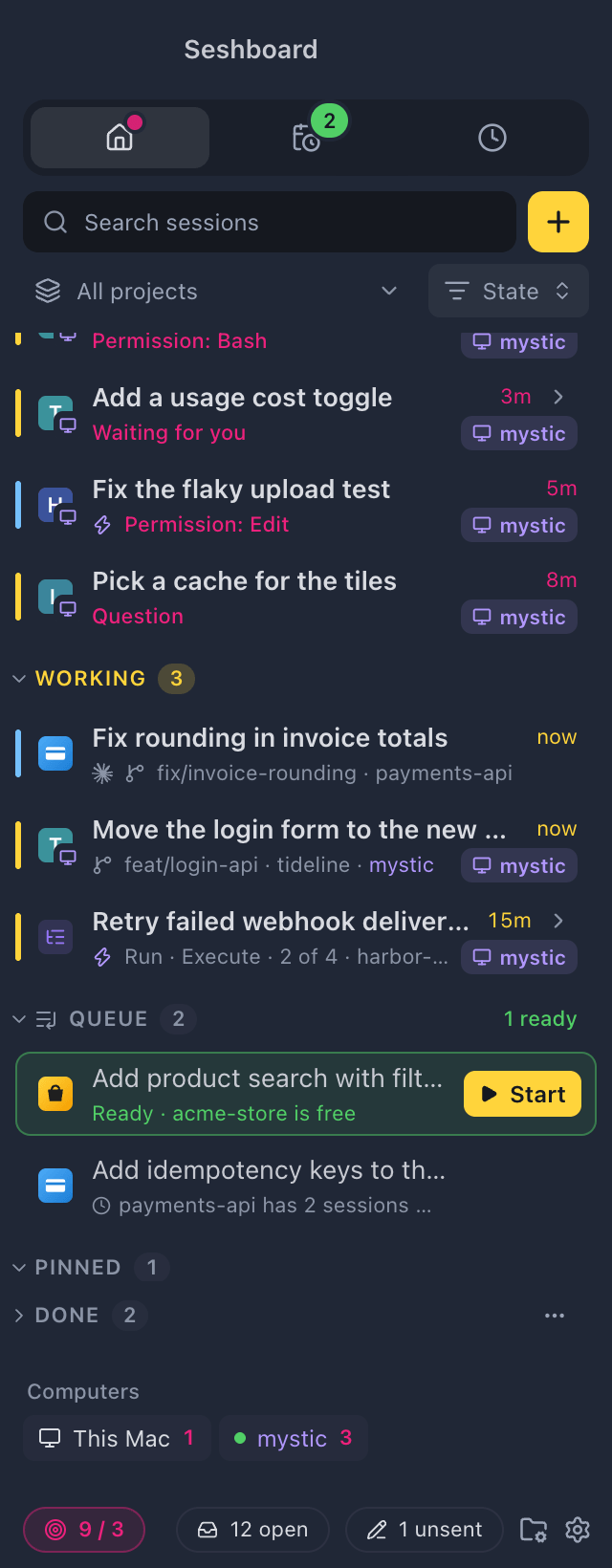
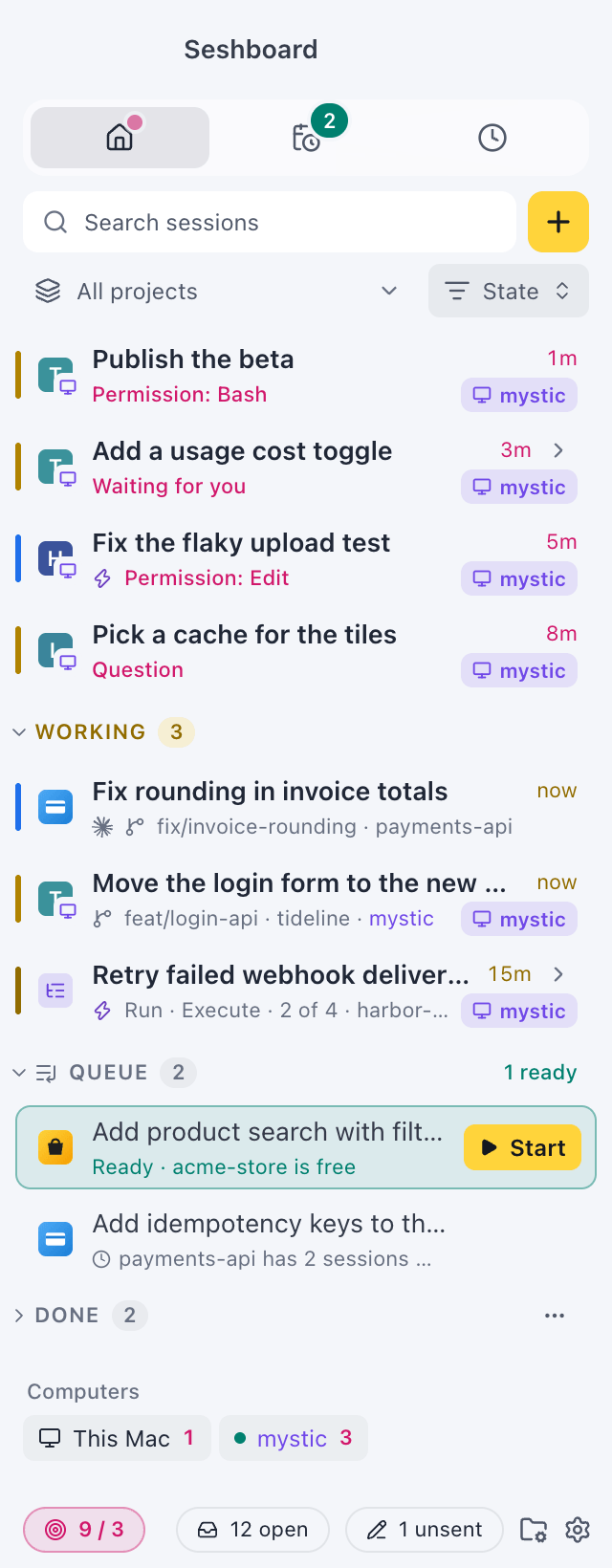
The Computers strip at the bottom of the sidebar has a chip for This MacThis PC and one for each paired computer, with a green dot when it is connected and, in pink, how many of its sessions need you. Click a chip to show only that computer’s sessions. Click it again to show all of them. In the project menu (All projects ▾), Show sessions from has a checkbox for each computer, and the other computers’ projects are listed with their chip. The command palette has Show only mystic for each connected computer. Each window keeps its own filter.
On a shared computer, the chip switches between your sessions and everyone’s. Right-click it, or click the ▾ that shows on hover, to pick Mine or All, kept for each computer. While Mine is on, a person shows after the computer’s name. Mine shows the sessions you started there from this computer, and the ones you sent a message to, answered or resumed from here. The chip’s menu says how many it hides, and a search still finds them. In All, other people’s sessions say who started them, after the branch. The chips that don’t fit fold into +N.
Search sessions at the top of the sidebar finds them by title, project, branch or computer name. Go to session in the command palette (Command, PControl, P) and Command, Shift, UControl, Shift, U include them too.
Start a session there
Section titled “Start a session there”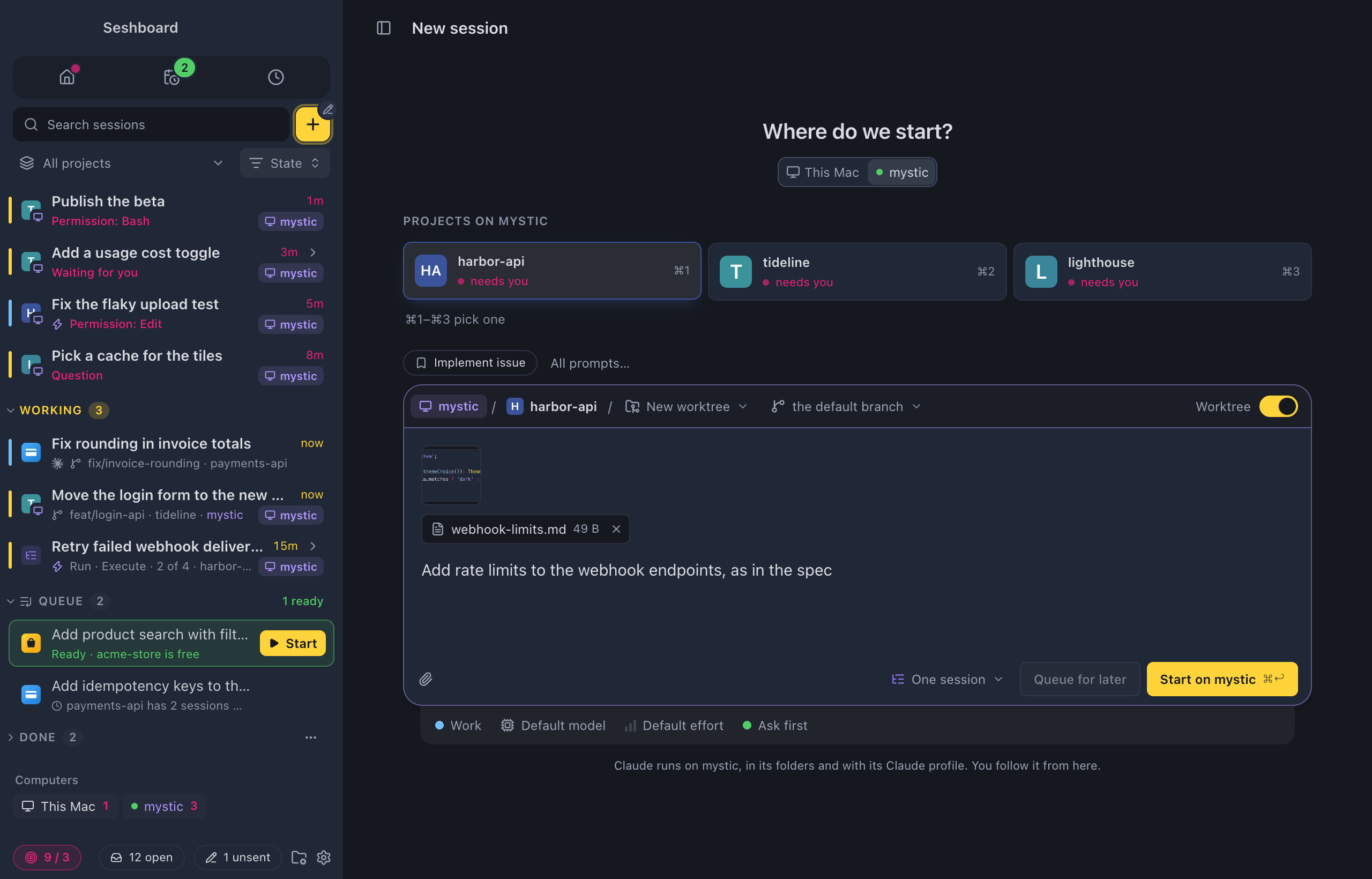
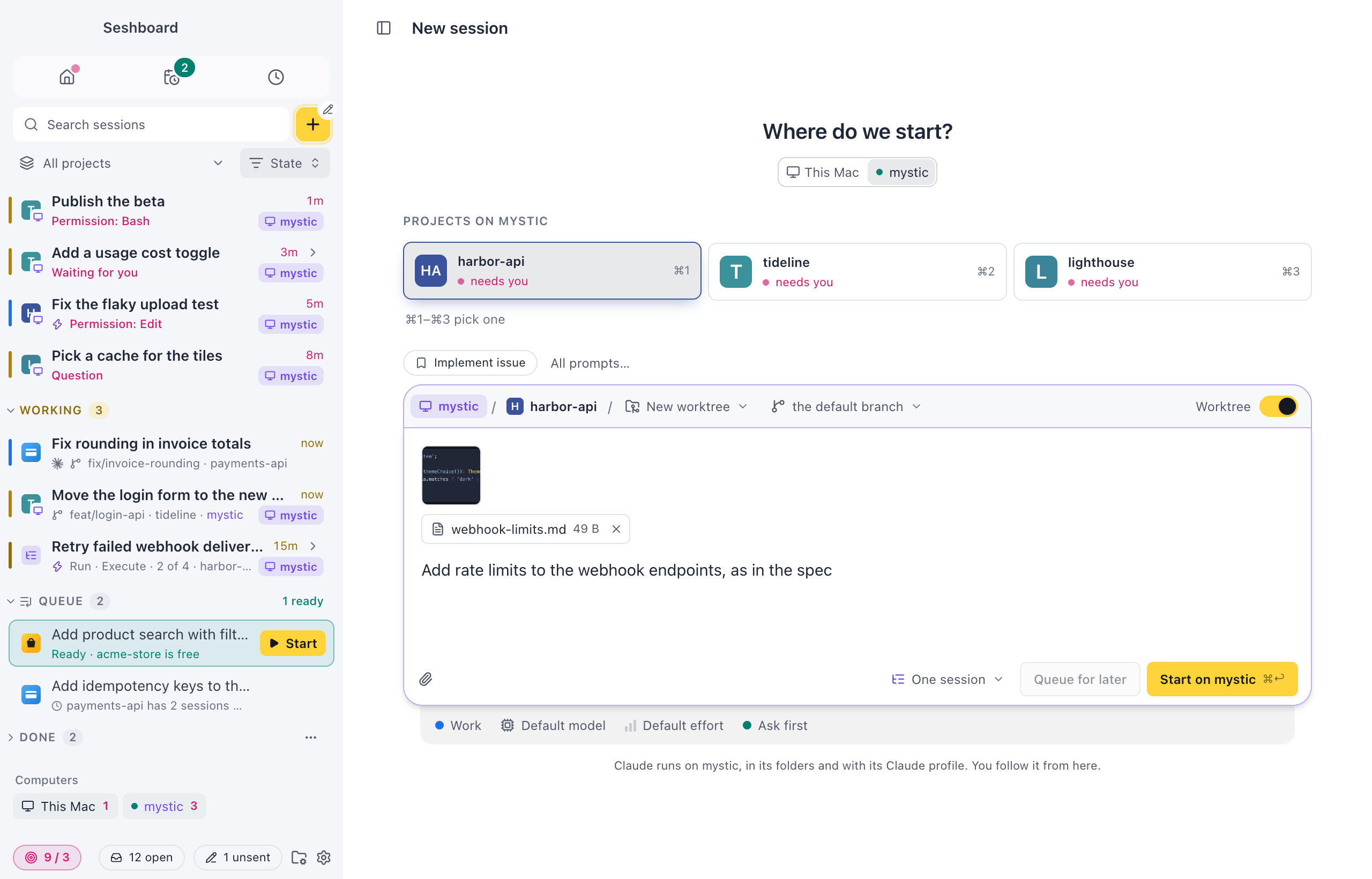
In New session, Run on picks the computer. Its projects fill the project list, and Start on mystic starts the session there. With New worktree, Branch from picks the branch the worktree starts from, and the branch menus list that computer’s remote branches too. New session keeps one unsent prompt for each computer, also after a restart. See Run on another computer. New session on mystic… in the command palette opens it with that computer picked.
With Clone from GitHub on here, Clone from GitHub… clones a repository on that computer, into its own Clone into folder, adds it as a project there and starts the session in it. Clone from GitHub has to be on in Settings › Projects on that computer too, and it needs this version of Seshboard there.
Its tokens in Usage
Section titled “Its tokens in Usage”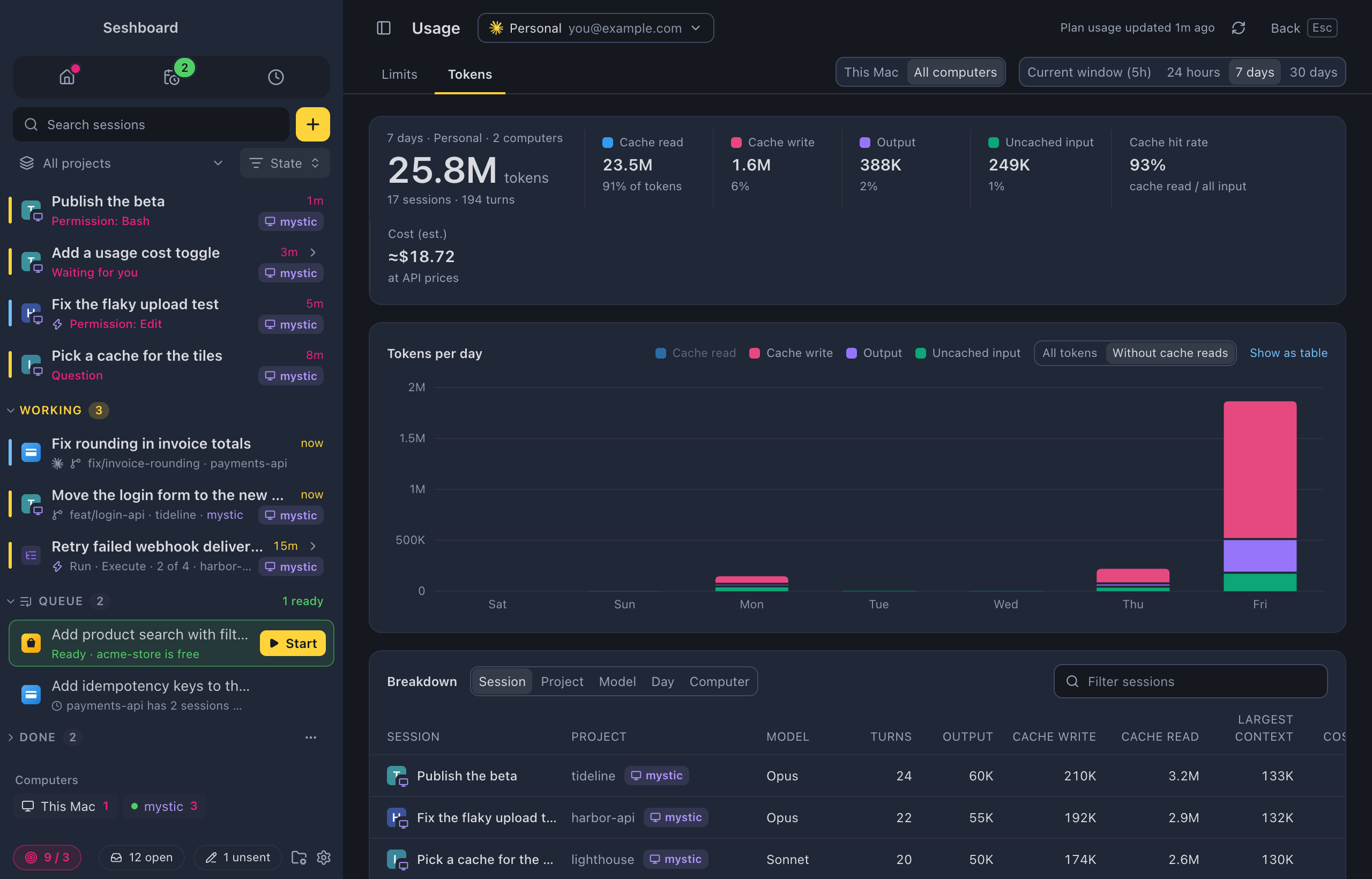
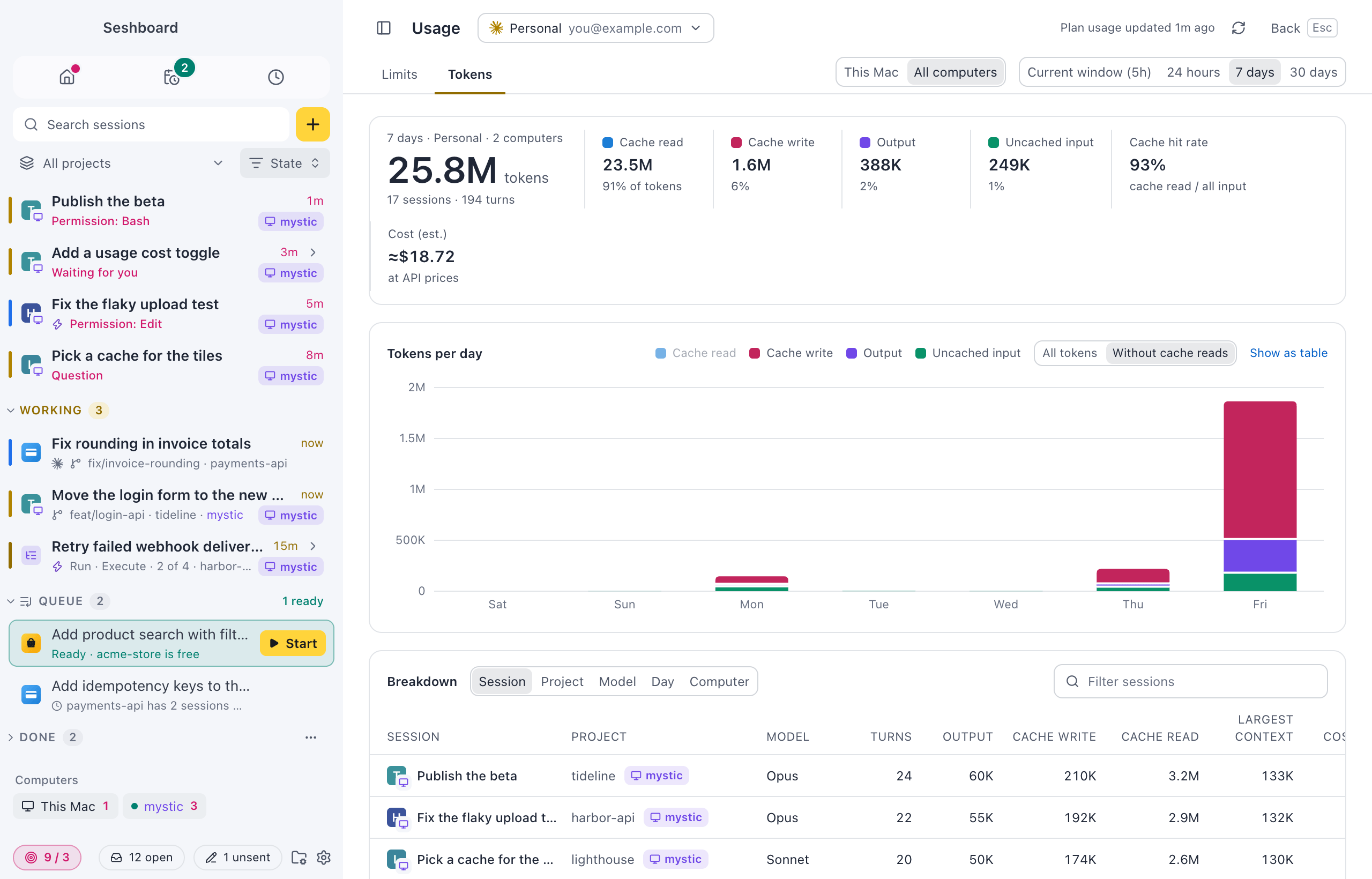
The Usage view adds up the tokens your claude.ai account used on the computers you paired, next to this one’s. All computers in its header turns it on, and the breakdown marks the other computers’ sessions with their name.
When a computer is offline
Section titled “When a computer is offline”Its sessions stay in the sidebar, dimmed, with when it was last seen: mystic is offline. Last seen 2h ago. An open session keeps its last messages under a banner, mystic is offline. Trying again in 30s., with Try again. The message box is off until the computer is back. A computer you remove takes its sessions with it.
When a computer can’t be read
Section titled “When a computer can’t be read”When a computer sends sessions this version can’t read, for example because it runs an older or newer Seshboard, they are left out instead of leaving the window empty. The computer’s page and its chip in the sidebar say what happened. Updating Seshboard on both computers fixes it.
Reconnect or remove
Section titled “Reconnect or remove”When the computer’s tunnel gets a new address, click Reconnect a paired device on it, Copy link, and paste that link under Other computers too. Open shows a computer’s page, and Remove takes it off this list. To stop a computer from reaching yours, Revoke it under Paired devices on yours. See Paired devices, Rename and Revoke.
Related
Section titled “Related”- Remote on your phoneFollow your sessions from your phone, answer Claude when it needs you, and send prompts, wherever you are.
- Split viewTile sessions next to each other and above each other, drag them into place and resize them.
- New sessionPick a project, choose where Claude works, write the first prompt and start.
- UsageSee what is left of your plan, when it comes back, and which sessions, projects and models used your tokens.